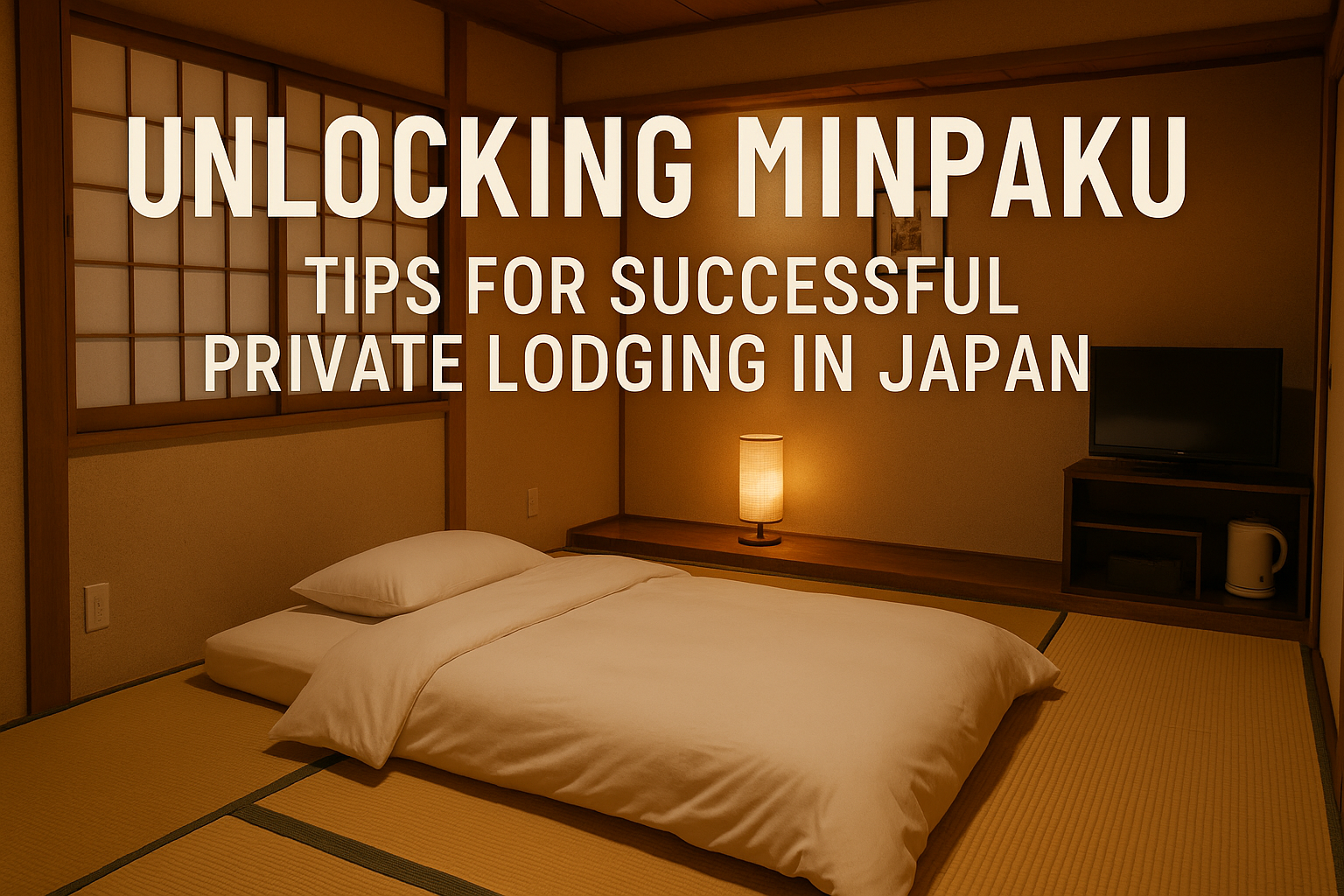
What is Minpaku?
The term minpaku (民泊, literally “private lodging”) is not clearly defined by Japanese law and regulations; however, it typically refers to accommodation services for travelers that use part or all of a residential property. These can include both apartments and detached houses. Services offered on platforms such as Airbnb or Booking.com may fall under this category.
In recent years, as Japan has become increasingly popular as a tourist destination, the number of minpaku services has grown exponentially. However, due to both ignorance and malpractice, many of these services operate without proper approval.
This situation has caused problems not only for neighbors of minpaku operations but also for unaware customers.
To prevent such incidents, the Japanese government established a set of rules and laws on June 6, 2017.
Let’s take a brief look at these regulations to raise awareness for both entrepreneurs and users.
Types of Lodging
| Category | Inns and Hotels Act (旅館業法, Simple Lodging) | Special Zone Private Lodging (特区民泊) | Private Lodging Business Act (住宅宿泊事業法) |
| Regulating Body | Ministry of Health, Labour and Welfare (MHLW) | Cabinet Office (with MHLW) | MLIT, MHLW, Japan Tourism Agency |
| Legal Requirement | Permission required | Authorization required | Registration required |
| Use in Residential Areas | Not allowed | Allowed (vary by municipality) | Allowed (can be limited by ordinance) |
| Days of Operation | No limit | No annual limit, but 2-night/3-day minimum stay | Max. 180 days/year (can be limited) |
| Guest Book (Registry) | Required | Required | Required |
| Entryway Standard | Not required | Not required | Not required |
| Minimum Floor Area | 33㎡ total or 3.3㎡ per guest (<10 guests) | 25㎡ per room (standard) | 3.3㎡ per guest |
| Hygiene Measures | Cleanliness, ventilation, lighting, etc. Clean room at checkcheck-in in. | Cleanliness, ventilation, lightning, etc. Clean room at check in. | Cleanliness, ventilation, lightning, etc. Clean room at check-in. |
| Safety Equipment | Required | Required (with exceptions for live-in hosts) | Required (with exceptions for live-in hosts) |
| Fire Equipment | Required | Required | Required (with some exceptions) |
| Neighborhood Relations | Not required | Required (guest rules, complaint system, garbage disposal guidelines etc) | Required (guest rules, complaint system, garbage disposal guidelines etc) |
| Manager Delegation | Regulated (must manage or outsource) | Regulated (must manage or outsource) | Regulated (must manage or outsource) |
-
- The Private Lodging Business Act is the most flexible for operating minpaku in residential areas, but it limits operation to 180 days/year and imposes responsibilities for safety and community relations.
-
- Special Zone Private Lodging is suitable for areas within deregulated zones (e.g., parts of Tokyo or Osaka), allowing longer stays but still requiring structured communication with guests and neighbors.
-
- The Inns and Hotels Act applies to traditional lodging (e.g., ryokan 旅館 or hotels) and is not suitable for casual hosts in residential areas.
As you can see, depending on the type of lodging you want to establish, you must obtain a minpaku license from the appropriate regulating body. Also, depending on the zoning (用途地域) of your property, certain lodging types may be restricted.
For example, people sometimes say that if you want to operate your minpaku for more than 180 days, you may need to “switch” to a hotel or ryokan license. While not technically incorrect, this is often unfeasible due to zoning limitations in residential areas.
Registration Requirements and Obligations
If you want to run an Airbnb-style business, you must:
-
- Register with the relevant authorities
-
- Submit a blueprint of the property
-
- Notify your neighbors
-
- Obtain approval from the Fire Department
Once licensed, you are required to display the license at the property.
Operators must follow 10 essential rules:
-
- Room Size & Cleanliness
At least 3.3㎡ per guest. Maintain cleanliness and ventilation.
- Room Size & Cleanliness
-
- Guest Safety
Provide emergency lighting, evacuation signs, and disaster precautions.
- Guest Safety
-
- Foreign-Language Guidance
Offer multilingual instructions for equipment, emergencies, and transport.
- Foreign-Language Guidance
-
- Lodger Registry
Verify guest identity and record information (including passport number for foreign guests) for 3 years.
- Lodger Registry
-
- Environmental Considerations
Instruct guests on waste disposal, noise control, and fire safety.
- Environmental Considerations
-
- Complaint Handling
Set up a responsive system to address neighborhood complaints.
- Complaint Handling
-
- On-Site Administrator
Required if the host is absent or there are more than 5 rooms.
- On-Site Administrator
-
- Use of Agents
If delegating tasks, use a registered minpaku agent or travel agency.
- Use of Agents
-
- Signage
Post a visible sign with your registration number.
- Signage
-
- Bi-monthly Reporting
By the 15th of every even-numbered month, report:
- Bi-monthly Reporting
-
- Number of hosting days
-
- Guest count and nationality breakdown
Can I operate a Minpaku from abroad?
Yes, but with a set of additional rules and some local regulations that vary from municipality or city.
Japanese law distinguishes between people who operate a minpaku in person (in loco) and those who manage it remotely or from overseas. If you plan to operate your minpaku while living far away or abroad, you must appoint someone to manage the property on your behalf.
This can be either an individual or a company. While the exact rules may vary depending on the municipality, the general guideline is that the appointed person or company must be able to reach the property within 10 minutes to 1 hour in case of emergencies or problems.
Using a professional management company can streamline operations, as they will help handle all the legal and administrative obligations. However, service fees typically range from 15% to 25% of gross rental revenue, depending on what services are included.
Tax Responsibilities
Minpaku income is taxable in Japan. Failure to declare could result in penalties and the loss of tax benefits.
What taxes apply?
-
- Income Tax (所得税)
If miscellaneous income exceeds ¥200,000/year, you must file a tax return.
- Income Tax (所得税)
-
- Consumption Tax (消費税)
Required if annual gross sales exceed ¥10 million (applies from the second year).
- Consumption Tax (消費税)
-
- Enterprise Tax (事業税)
Levied by prefectures on income above ¥2.9 million/year.
- Enterprise Tax (事業税)
-
- Accommodation Tax (宿泊税)
Imposed by some cities (e.g., Tokyo, Osaka).
- Accommodation Tax (宿泊税)
Income Classification
Your minpaku income may fall under different categories:
-
- Miscellaneous Income (雑所得): Small-scale, side businesses. Losses cannot be offset.
-
- Real Estate Income (不動産所得): When existing rental units are occasionally used for minpaku.
-
- Business Income (事業所得): For continuous, large-scale operations. Losses can be offset; eligible for blue-form tax benefits.
Classification affects the deductions you can claim.
What expenses are deductible?
You may deduct:
-
- Airbnb or platform fees
-
- Utilities (proportional to business use)
-
- Internet and phone costs
-
- Cleaning, furnishings, and supplies
-
- Depreciation of large assets
-
- Interest on business-related loans
If your home is also your minpaku, you must allocate expenses accordingly between personal and business use.
Risk of Losing Tax Benefits
Operating a minpaku may disqualify your property from certain tax advantages:
-
- Fixed asset tax reductions for residential properties
-
- Inheritance tax reduction for small lots
-
- ¥30 million capital gains exemption when selling your home
-
- Mortgage interest deductions (if personal use falls below 50%)
These consequences can be significant—especially if your minpaku grows beyond a side business.
Final Thoughts
Operating a minpaku in Japan can be a rewarding opportunity ,whether as a side business or a full-time venture, but it comes with legal responsibilities, zoning challenges, and tax implications.
Understanding the rules set by both national and local authorities is essential to avoid costly mistakes and to ensure a safe and positive experience for guests and neighbors alike.
If you’re considering starting your own minpaku, make sure to review the legal framework, understand the restrictions in your area, and choose the licensing route that best fits your goals and property location.
In a separate article, I’ll dive into Ōta-ku (大田区), the only ward in Tokyo where tokku minpaku (特区民泊, special zone lodging) is officially permitted. If you’re looking to operate beyond the standard 180-day limit or want to explore more flexible hosting options, it’s a topic worth reading about.
Thinking About Starting?
If you’re planning to list a room on Airbnb, turn an unused apartment into a short-term rental, or just want to understand your rights and obligations as a property owner in Japan, being informed is the first step.
Have questions or want to share your own minpaku experience? Feel free to reach out or leave a comment. I’m always happy to connect.

 Italian
  English